The question of whether
there is water on Mars has been hotly debated for decades. It has generally
been proven that water exists on Mars, though it’s mostly trapped in its ice
form. For life to exist as we know it, liquid water is a vital component. Because
Mars has such a thin atmosphere, liquid water on the surface isn’t stable and
will immediately boil off. This makes it very tricky to even begin to try to
observe liquid water. Recently however, using radar instruments, Italian
researchers have discovered evidence of a large, liquid water lake beneath the
glaciers at the southern pole of Mars.
Aboard the EU’s Mars Express spacecraft is a
special instrument called a radar sounder. Radar sounders work by shooting
specific frequencies of radar pulses at the surface of a planet and then
observing the reflected signal. This can be thought of like clapping in a cave
and listening to the echo that comes back to you. Depending on what the echo
“sounds” like, scientists can gain a wealth of information about whatever
surface they aimed the instrument at. Differing frequencies used by the
instrument contain information about the surface rock, ice, or even what lies
beneath the surface.
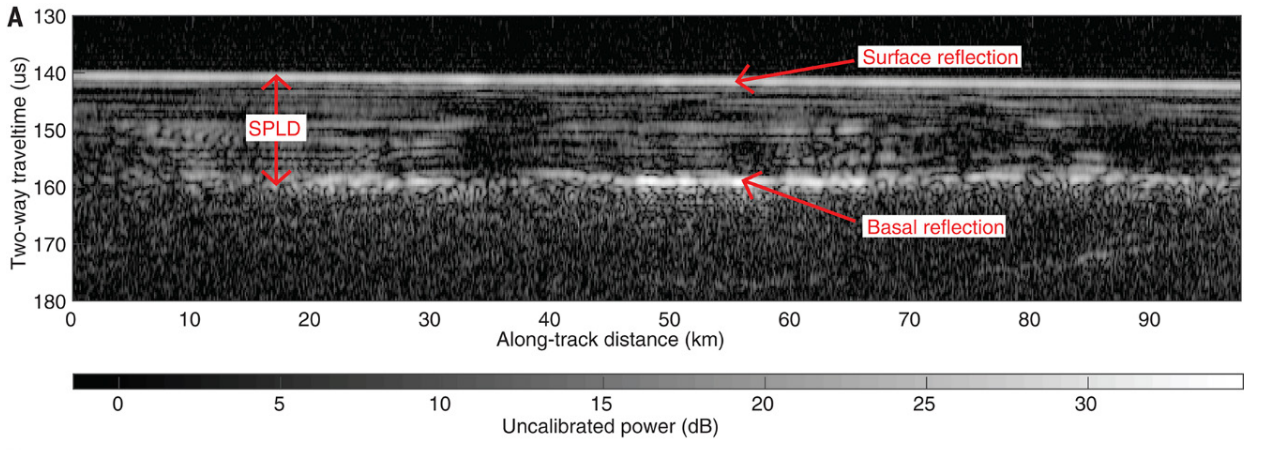 |
| Figure 1: Radargram of the subglacial lake. In this figure, the x-axis is horizontal distance on the planet, and the y-axis is the time is takes the radar signal to bounce back to the spacecraft, which can be interpreted to understand subsurface topography. This figure can be thought of as a cross section. The subglacial lake can be seen at the basal reflection label. The SPLD label shows the South Polar Layered Deposit, which is an area of the south pole where pure water ice is formed in layers. Figure 2A from Orosei et al. (2018). |
Using a radar sounder named MARSIS, Italian
scientists made several flybys of the south pole region, which is mostly
covered in water-ice glacier year round. What they found were bright subsurface
radar reflections where, ordinarily, there should be nothing (fig.1). When you
shoot a radar wave at a material, the target’s atoms will react by becoming
electrically polarized to varying degrees (the atoms will have one side become
more positive than the other, or vice versa). This degree of polarization can
be unique for different materials, so it’s a great way to identify materials
hidden in the subsurface. This quality of materials is known as dielectric
permittivity. By analyzing the MARSIS radar reflections, the scientists
discovered that the dielectric permittivity of the anomalous reflection matched
that of water-bearing materials. By making several flybys of the area, the
scientists were able to map out the subglacial lake and found it to be about 20
km wide and approximately 1.5 km beneath the surface (fig.2)

| Figure 2: This image shows the estimated size of the lake. Radar tracks are colored depending on subsurface elevations with warmer colors corresponding to higher elevations and cooler corresponding to lower elevations. The perceived lake is marked by the bold, black line. Figure 3A from Orosei et al. (2018). |
Does this confirm that there’s a subglacial lake
at Mars south pole? It’s very likely. (SHARAD, another radar sounder orbiting
Mars, didn’t see the lake, though this may be to due to the different set of
frequencies SHARAD uses). Does this confirm that there’s life on Mars? Not yet.
For all we know, the lake could be completely inhospitable, or might not even
be there in the first place! What this study does provide is compelling
evidence that the secrets to extraterrestrial life in our solar system might be
hiding under some ice, just one planet away!
Orosei, R., Lauro, S. E., Pettinelli, E.,
Cicchetti, A., Coradini, M., Cosciotti, B., … Seu, R. (2018). Radar evidence of
subglacial liquid water on Mars. Science,
361(6401), 490 LP-493. Retrieved from
http://science.sciencemag.org/content/361/6401/490.abstract


